Featured
Fortress Football: Empire, Anti-Blackness and the Capture of the Beautiful Game

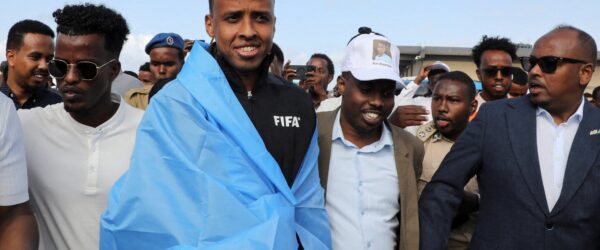
Omar Abdulkadir Artan returns home
The 2026 FIFA World Cup will unfold during a period of intensifying U.S. militarism, imperial consolidation and border securitisation. Rather than standing outside these realities, the tournament risks functioning as spectacle for empire — projecting “global unity” while systems of extraction, anti-Blackness and unequal mobility deepen globally. Yet football mega-events have perhaps never been politically neutral. From the 1934 World Cup staged under Benito Mussolini’s fascist regime to the 1978 tournament hosted under Argentina’s military dictatorship, global football has repeatedly been mobilised to legitimise authoritarianism, elite power and geopolitical influence. The question is therefore not whether football is political, but whether the game can resist capture by corporations, militarised borders and increasingly authoritarian forms of governance.
The 2026 tournament arrives amid escalating geopolitical instability and declining U.S. legitimacy globally. Ongoing support for Israel’s assault on Gaza, confrontation with Iran, sanctions against Cuba and Venezuela, and the expansion of military infrastructures all form part of a broader architecture of imperial control. The United States maintains roughly 750 military bases globally and spends close to a trillion dollars annually on military infrastructure and warfare. In this context, the World Cup becomes useful soft power at a moment when U.S. authority is increasingly contested. Football is used to project openness and multiculturalism while borders harden and migration is criminalised. As sports scholar Jules Boykoff has argued, mega-events increasingly function as political spaces where expanded state power is normalised through spectacle.
FIFA meanwhile presents itself as politically neutral while functioning as one of the most powerful corporate institutions in global sport. FIFA generated approximately $7.5 billion during the Qatar World Cup cycle while host states and cities absorbed enormous public costs. Mega-events are routinely sold through the language of jobs, regeneration and economic opportunity, yet the outcomes are often far more uneven. The 2012 London Olympics were promoted as a vehicle for regenerating East London, yet researchers and local activists documented rising property values, displacement pressures and accelerated gentrification across areas such as Hackney Wick and Stratford. Similar dynamics emerged elsewhere. In South Africa 2010, FIFA exclusion zones restricted informal traders and local vendors from accessing lucrative commercial spaces around stadiums and fan parks. In Brazil 2014, stadium expansion and urban redevelopment displaced poor and largely Black communities while billions in public resources flowed into tournament infrastructure. In each case, the language of regeneration concealed a transfer of value: from public to private, from local to global, and from communities to corporations. Ticket pricing and corporate hospitality increasingly exclude ordinary supporters and working-class football culture. The World Cup increasingly resembles a heavily securitised corporate commodity rather than a genuinely public sporting festival.
The 2026 tournament also risks deepening border securitisation under the language of “World Cup security.” Canada, Mexico and the United States have already outlined trilateral security coordination frameworks for the tournament, including cross-border policing and security cooperation. Human rights groups have warned that the U.S. World Cup may create a climate of fear for fans, workers and journalists because of aggressive immigration enforcement and visa uncertainty including for players. Fans from countries outside the U.S. Visa Waiver Program must obtain visitor visas to attend matches in the United States. U.S. visa refusal rates remain extremely high for several African and Global South countries, meaning the tournament’s promise of “global unity” will be filtered through deeply unequal mobility regimes before many supporters even reach the stadium. Sponsors, executives and wealthy tourists move through expedited systems while supporters from Africa, the Caribbean, the Arab world and Latin America confront suspicion, delays and exclusion. The border is not outside the tournament. It is one of the tournament’s hidden infrastructures.
One of the opening matches of the tournament, Haiti versus Scotland, symbolically exposes many of these contradictions. Haiti represents one of the greatest anti-colonial victories in modern history: the only successful slave revolution resulting in the first Black republic in the Western hemisphere. France imposed an “independence debt” that extracted wealth from Haiti for generations after liberation, while the United States continued cycles of occupation and intervention. As Jemima Pierre argues, Haiti remains a powerful illustration of how anti-Blackness operates through intervention, debt, dispossession and containment rather than through overt racism alone.
The anti-Black architecture of the World Cup is similarly visible not only on the pitch but in how mega-events reorganise cities, ownership and economic opportunity. FIFA 2010 in South Africa demonstrated how the benefits of the tournament were often captured by global corporations while indigent and working-class communities were pushed to the margins. Informal traders and local vendors were excluded from lucrative trading zones around stadiums and fan parks while FIFA-controlled commercial spaces prioritised licensed sponsors and approved vendors. Similar dynamics emerged in Brazil 2014, where urban “beautification” and securitisation displaced poor and largely Black communities. Racism within football itself also remains deeply entrenched despite FIFA’s diversity campaigns. Black players continue to face racist abuse across elite football systems, from the treatment of Vinícius Júnior in Spain to repeated incidents across European football. As Amira Rose Davis reminds us, sport is inseparable from broader struggles over race, labour, citizenship and belonging. Ben Carrington similarly argues that modern sport often celebrates Black visibility while resisting deeper transformations in power and inequality.
Yet football became the world’s game because it was a working-class game: built in factories, docks, mines, plantations, townships and marginalised urban communities long before FIFA transformed it into corporate spectacle. The exclusion of ordinary supporters through pricing, securitisation and corporate hospitality is therefore not incidental — it is the displacement of the very communities that built the game itself. Football has historically carried anti-colonial and democratic possibilities, from Algerian liberation organising to township football under apartheid and Palestinian football under occupation.
The next World Cups, including those linked to Morocco and Saudi Arabia, will raise many of these same questions again: who controls global football, who profits from mega-events, whose labour and land are mobilised, and whether football can remain public culture rather than elite spectacle. Reclaiming football therefore means resisting its capture — by authoritarianism, by corporations, by militarised borders and by elite governance structures that increasingly displace the very communities that made the game global in the first place.
As Eduardo Galeano once wrote, football’s history is a struggle between the joy of the game and the demands of the market. The question is no longer whether football is political. The question is whether football can survive the militarised and unequal order increasingly governing the world itself.
(By Lebohang Liepollo Pheko and Anna Marie Collins)
(Photo Credit: Feisal Omar/Reuters)
From 1976 to 2026, neither peace nor ceasefire have ever been keywords. So what?
“The blues remembers everything the country forgot” Gil Scott-Heron and Brian Jackson, “Bicentennial Blues” What does it mean to forget the meaning of peace? Of ceasefire? Or, what does it mean to never have known? In 1976, the year of the United States Bicentennial, the Welsh activist scholar Raymond Williams published Keywords: A Vocabulary of […]

With “seclusion rooms” in schools, the war on children with disabilities continues
This week, NPR reported rampant abuse of Native American children in schools in a district in upstate New York: “Native kids with disabilities were held in wooden boxes. Sweeping reforms are coming”. The story is deeply disturbing. Schools built wooden boxes, “timeout” spaces”, and confined children with disabilities, children in majority Mohawk districts, into […]
Empty words that empty us: ceasefire
because your side of the cease-fire was holding since more than a year before they said so what June Jordan, “Apologies to All the People in Lebanon” Today, The New York Times (finally) thankfully revealed the truth we already know and have known: “Russia-Ukraine War Shows Cease-Fires Have Lost Meaning Under Trump”. For the past […]

On which seashore of endless worlds do children meet?
On the seashore of endless worlds children meet. The infinite sky is motionless overhead and the restless water is boisterous. On the seashore of endless worlds the children meet with shouts and dances. They build their houses with sand, and they play with empty shells. With withered leaves they weave their boats and smilingly […]

On record-breaking: When you care enough to send the very best …
“Whoever’s homeless now, will build no shelter; who lives alone will live indefinitely so” Rainer Maria Rilke, “Day in Autumn” Today, it is reported that homelessness in Western New York state hit “a record high”. The current level is “the highest recorded since data collection began in 2005, and 24% up from just last […]

The racist `normal’ of deed theft: near death, near-death, or nearly dead
Sustaining today’s waves of spectacular violence is a web of everyday violence, the violence of the normal. This week’s example of that is deed theft. In Brooklyn last Wednesday four people were arrested at a protest against deed theft “after gathering outside a brownstone in support of a woman who is fighting attempts to evict […]

I do know this can’t happen to anyone else, ever again: is this the end of childhood?
Five years ago, the United Kingdom public was “shocked” to learn the story of child Q, a 15-year-old Black girl in Hackney. Child Q was at school. She was “suspected” of having cannabis. The police were called. The police strip-searched the child. The child was menstruating. Of course, the police found no contraband: “A council […]

In New South Wales, where are the First Nations women? In prison, still discarded and ignored
Last week, the New South Wales Auditor General released a report, “Support for First Nations peoples in custody and post-release to reduce reoffending.” To absolutely no one’s surprise, the report shows that the state has failed to address the needs of incarcerated (or any) Indigenous people, or, better put, the state has successfully tortured Indigenous […]

“This place broke something in us. Something that I don’t know if we will ever be able to fix”
“Before I built a wall I’d ask to know What I was walling in or walling out, And to whom I was like to give offense. Something there is that doesn’t love a wall, That wants it down.” Robert Frost, Mending Wall When do we start to care? What is the threshold of our […]

Households with children experienced a sharp increase in food insufficiency soon after the eviction moratorium ended
We live amid (reports of) orchestrated, organized violence against children – bombs dropping on schools in Gaza, Iran, Sudan; children kidnapped by masked agents of the State across the United States; children strip-searched in prisons across the world; and so much more performed in the name of “national security”. These all garner and deserve whatever […]